



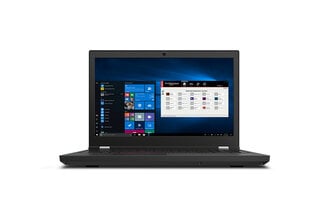

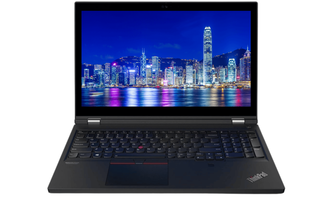

The ThinkPad P15 Gen 2: RTX A power, 128 GB and three SSD slots
The Lenovo ThinkPad P15 Gen 2 is a 15.6 inch workstation laptop with an 11th gen Intel Core i5, i7 or i9 or an Intel Xeon W, an NVIDIA T1200 or an RTX A card from the RTX A2000 up to the RTX A5000 with 16 GB, four memory slots for up to 128 GB and three SSD slots. On top of that come two Thunderbolt 4 ports, 2.5 gigabit Ethernet, Wi-Fi 6E and an optional 4K OLED touchscreen. It is the most powerful model in the P15 line: a mobile workstation for heavy BIM, rendering and simulation work and for AI applications that need video memory.
On this page you can read, part by part, what the P15 Gen 2 can do, what has changed compared with the Gen 1 and which graphics card suits which kind of work. Whether you want a refurbished Lenovo laptop for AutoCAD and BIM, or a workstation for GPU rendering and machine learning, you will know which configuration you are looking for.
At a glance: 15.6 inch 16:9, Full HD, 4K IPS or 4K OLED touch · Intel Core i5/i7/i9 or Xeon W, 11th gen, 6 or 8 cores · NVIDIA T1200, RTX A2000, A3000, A4000 or A5000 · up to 128 GB DDR4-3200 in 4 slots · 3x M.2 SSD, one of them PCIe 4.0 · 2x Thunderbolt 4 · from 2.87 kg.
Frequently asked questions about the ThinkPad P15 Gen 2
Which graphics card does the ThinkPad P15 Gen 2 have?
An NVIDIA T1200 (4 GB), RTX A2000 (4 GB), RTX A3000 (6 GB), RTX A4000 (8 GB) or RTX A5000 (16 GB), all with GDDR6, depending on the configuration. The card in your unit is listed with the product.
Which P15 Gen 2 should I choose for Revit or rendering?
Choose at least an RTX A3000 with 6 GB of video memory. The RTX A4000 with 8 GB and the RTX A5000 with 16 GB are intended for large scenes, GPU rendering and AI. For AutoCAD and lighter 3D work the T1200 and the RTX A2000 are enough.
How many SSDs fit in the P15 Gen 2?
Three. There are three M.2 slots: two on PCIe 3.0 and one on PCIe 4.0, each for an SSD of up to 2 TB. You can set up RAID 0 or 1 on the two PCIe 3.0 slots.
How much memory does the P15 Gen 2 support?
Up to 128 GB DDR4-3200 across four SO-DIMM slots, using four 32 GB modules. With a Xeon processor and ECC modules it works with ECC memory.
What is the difference between the P15 Gen 2 and the P15v Gen 2?
The P15 has more powerful graphics cards up to the RTX A5000, four memory slots for up to 128 GB, three SSD slots, two Thunderbolt 4 ports and Xeon options. The P15v weighs from 2.07 kilograms and is more affordable, with at most an RTX A2000 at 35 watts and 64 GB.
How heavy is the ThinkPad P15 Gen 2?
From 2.87 kilograms without a touchscreen and from 3.07 kilograms with a touchscreen. Without a touchscreen it is 24.5 to 31.45 millimetres thick.
Is the P15 Gen 2 suitable for AI and machine learning?
Yes, especially with the RTX A4000 or RTX A5000, because video memory determines how large a model can be. Lenovo also offered it with Ubuntu and Data Science Preload, with preinstalled tools.
Does the P15 Gen 2 have Thunderbolt 4 and a SIM card slot?
It has two Thunderbolt 4 ports, alongside a USB-C 3.2 Gen 2 port and two USB-A ports. Only configurations with a 4G module have a nano SIM card slot; whether your unit has 4G is listed with the product.
What is new compared with the Gen 1?
From the outside the P15 Gen 2 looks very much like the Gen 1: the same 375.4 x 252.3 millimetre footprint, the same keyboard with numeric keypad and the same layout with four memory slots. The biggest change is the graphics card. Where the Gen 1 still had Quadro T and Quadro RTX cards, the Gen 2 gets the NVIDIA T1200 or the RTX A2000, A3000, A4000 and A5000, all with GDDR6.
There are also three M.2 slots instead of two, one of them PCIe 4.0, Thunderbolt 4 instead of Thunderbolt 3, 2.5 gigabit Ethernet instead of 1 gigabit, Wi-Fi 6E instead of Wi-Fi 6 and HDMI 2.1 instead of HDMI 2.0. Memory moved from DDR4-2933 to DDR4-3200, still up to 128 GB. The Gen 2 was also offered with Windows 11 and has passed the newer MIL-STD-810H military testing. It is a little heavier, though: from 2.87 kilograms versus 2.74 kilograms for the Gen 1 with a Full HD screen.
Processor: Core i5 to Core i9 and Xeon W
The P15 Gen 2 shipped with processors from Intel's 11th gen H series. The Core i5-11500H has 6 cores and 12 threads up to 4.6 GHz. The Core i7-11800H, i7-11850H and i9-11950H all have 8 cores, 16 threads and 24 MB of cache, and differ mainly in clock speed: up to 4.6, 4.8 and 5.0 GHz. The Xeon W-11855M has 6 cores up to 4.9 GHz, the Xeon W-11955M 8 cores up to 5.0 GHz.
What does that mean when choosing? Because the i7 and i9 have the same number of cores and the same cache here, the difference between an i7 and an i9 is smaller than the name suggests. For rendering, compiling and simulation, which use all cores, you get a lot out of any eight-core configuration. The higher clock speed of the i9 and the W-11955M mainly helps with modelling and drafting, where software often relies on one or a few cores. Choose a Xeon if you want to use ECC memory, which detects and corrects memory errors during long calculations. Configurations with Intel vPro can be managed remotely by an IT department. See also our Intel Core i7 laptops.
The graphics card: NVIDIA T1200 to RTX A5000
Lenovo offered the P15 Gen 2 with an NVIDIA T1200 (4 GB GDDR6, 60 watts), RTX A2000 (4 GB GDDR6, 60 watts), RTX A3000 (6 GB GDDR6, 90 watts), RTX A4000 (8 GB GDDR6, 90 watts) or RTX A5000 (16 GB GDDR6, 90 watts). The wattage is the maximum power the card may use; a higher limit gives the card more room to stay fast under sustained load. The RTX A cards support Dynamic Boost 2.0, which shifts power between processor and graphics card depending on which is under the heaviest load, and have hardware for ray tracing and AI workloads. The P15 Gen 2 is ISV certified; which applications and versions Lenovo has had tested is listed on Lenovo's ISV list.
If you mainly want a laptop for AutoCAD and lighter 3D work, the T1200 or RTX A2000 is enough. If you work with Revit, Enscape, Twinmotion or V-Ray, the RTX A3000 with 6 GB is the practical minimum. The RTX A4000 and RTX A5000 are intended for large scenes, GPU rendering and AI, where video memory determines how large a model or dataset can be. Also note the difference with the P15v Gen 2: there the RTX A2000 runs at up to 35 watts, in the P15 Gen 2 at 60 watts. See also our laptops with a graphics card.
The display: Full HD, 4K IPS or 4K OLED
The Gen 2 also has a 15.6 inch 16:9 screen. The base option is an anti-glare Full HD IPS panel at 300 nits with a 700:1 contrast ratio and 100 percent sRGB, a clear improvement over the Gen 1 base screen, which covers 72 percent NTSC. Above that is a 500 nit Full HD screen with 100 percent sRGB, a 1200:1 contrast ratio and Dolby Vision. The 4K IPS screen (3840 x 2160) has 600 nits, 100 percent Adobe RGB, Dolby Vision and DisplayHDR 400. The top option is a 4K OLED touchscreen at 400 nits, with 500 nits peak brightness, a 100,000:1 contrast ratio, 100 percent DCI-P3, Dolby Vision and DisplayHDR True Black 500. The 4K screens were available with X-Rite factory calibration, and the OLED screen works with the Lenovo Pen Pro.
What does that mean for you? Thanks to full sRGB coverage, even the base screen is suitable for photo work for the web and social media. Adobe RGB is the wider colour gamut for photos that will be printed, DCI-P3 the standard for video; for print and video a 4K screen is therefore the better choice. On the IPS screens HDR only works in hybrid mode, in which the laptop switches between the Intel graphics and the NVIDIA card. Also see our 4K laptops and touchscreen laptops.
Memory and storage
The P15 Gen 2 has four SO-DIMM slots for DDR4-3200, in dual channel, up to 128 GB with four 32 GB modules. Because all memory sits in removable modules, you can start with 32 GB and upgrade later. With a Xeon processor and ECC modules it runs with ECC memory. That makes it suitable for large point clouds, simulations and several virtual machines at once, work that often runs out of memory before it runs out of processor.
For storage there are three M.2 2280 slots: two on PCIe 3.0 x4 and one on PCIe 4.0 x4, each for an SSD of up to 2 TB. A PCIe 4.0 SSD in a PCIe 3.0 slot works, but at PCIe 3.0 speed. On the two PCIe 3.0 slots you can set up RAID 0 or 1; RAID 1 mirrors two SSDs, so your work survives if one fails. The SSDs support Opal 2.0 encryption, but not in RAID mode. A common setup is the system and your active projects on the fast PCIe 4.0 SSD and your archive on a second drive. Storage varies per unit and is always listed with the product.
Ports, networking and docking
The P15 Gen 2 has two Thunderbolt 4 ports (40 Gbps, with DisplayPort 1.4a), a USB-C 3.2 Gen 2 port with DisplayPort, two USB-A 3.2 Gen 1 ports, one of them Always On, HDMI 2.1, an SD card reader, a 2.5 gigabit Ethernet port with Wake-on-LAN and an audio jack. Over HDMI you get up to 8K at 60 Hz with an RTX card and up to 4K at 60 Hz with the T1200. Over Thunderbolt and USB-C it goes up to 5120 x 3200 at 60 Hz. In hybrid mode it drives up to four external monitors next to the built-in screen.
Wireless, it has Wi-Fi 6E and Bluetooth 5.1. A smart card reader and a 4G module (4G LTE CAT16) with eSIM are optional. Only configurations with that 4G module have a nano SIM card slot. See also our laptops with SIM card.
Charging is through a 170 or 230 watt slim tip adapter; the USB-C ports supply power to peripherals but do not charge the laptop itself. Over Thunderbolt 4 you connect monitors, network and peripherals with one cable at the office. See our Lenovo docking stations.
Build, keyboard and security
The Gen 2 measures 375.4 x 252.3 millimetres and is 24.5 to 31.45 millimetres thick without a touchscreen, 25.25 to 32.2 millimetres with one. It weighs from 2.87 kilograms, or from 3.07 kilograms with a touchscreen. The top is made of plastic reinforced with 50 percent glass fibre, the bottom of polyamide with 50 percent glass fibre, and it has passed MIL-STD-810H military testing. The spill-resistant keyboard is backlit and has a numeric keypad and a three-button TrackPoint.
The webcam is 720p, optionally with infrared for Windows Hello, and has a privacy shutter. Stereo speakers with Dolby Atmos and two far-field microphones give good sound on video calls. For security there is a TPM 2.0 chip, a fingerprint reader in the palm rest, a self-healing BIOS and a Kensington slot.
Linux or Windows 11
Lenovo shipped the P15 Gen 2 with Windows 11 Pro, Pro for Workstations or Home, with Windows 10, with Fedora Linux or with Ubuntu Linux LTS. There was also an Ubuntu configuration with Data Science Preload, with preinstalled tools for data analysis and machine learning. It is also certified for Red Hat Enterprise Linux 8.4. Whether you want Windows 11 or a Linux laptop with official support from the manufacturer, the P15 Gen 2 is a good fit. See also our Linux laptops and Windows 11 laptops.
ThinkPad P15 Gen 2 specifications
| Component | ThinkPad P15 Gen 2 |
|---|---|
| Processor | Intel Core i5-11500H, i7-11800H, i7-11850H, i9-11950H, Xeon W-11855M or W-11955M |
| Graphics | NVIDIA T1200 (4 GB), RTX A2000 (4 GB), RTX A3000 (6 GB), RTX A4000 (8 GB) or RTX A5000 (16 GB) |
| Memory | Up to 128 GB DDR4-3200, 4 slots, ECC with Xeon |
| Storage | 3x M.2 2280 NVMe (2x PCIe 3.0, 1x PCIe 4.0), up to 2 TB each |
| Display | 15.6 inch 16:9: Full HD 300 or 500 nits, 4K IPS 600 nits or 4K OLED touch |
| Ports | 2x Thunderbolt 4, 1x USB-C 3.2 Gen 2, 2x USB-A, HDMI 2.1, SD card reader, 2.5 gigabit Ethernet, audio |
| Wireless | Wi-Fi 6E, Bluetooth 5.1, optional 4G with SIM card slot |
| Optional | Smart card reader, IR camera, vPro |
| Adapter | 170 or 230 watt slim tip |
| Weight | from 2.87 kg (touch from 3.07 kg) |
| Operating system | Windows 11 or 10, Ubuntu and Fedora preinstalled, certified for Red Hat Enterprise Linux 8.4 |
Source: Lenovo PSREF, specifications ThinkPad P15 Gen 2. The exact configuration of your unit is listed with the product.
Where the Gen 2 fits in the family
The Gen 2 builds on the Lenovo ThinkPad P15 Gen 1, which has the same dimensions and also up to 128 GB of memory, but 10th gen processors, Quadro cards, Thunderbolt 3 and two SSD slots. If you want a lot of workstation for your money, the Gen 1 with a Quadro RTX 3000 or higher is a smart alternative. If you want the RTX A cards, the third SSD slot or Wi-Fi 6E, choose the Gen 2.
If you want the same processor generation in a lighter and more affordable chassis, look at the ThinkPad P15v Gen 2: from 2.07 kilograms, but with two memory slots for up to 64 GB, at most an RTX A2000 at 35 watts and one Thunderbolt 4 port. For a slim workstation, the ThinkPad P1 Gen 4 with RTX A cards is a strong choice. All models are in the ThinkPad P15 series overview.
Who is the P15 Gen 2 for?
The P15 Gen 2 is meant for professionals who want the most out of a mobile workstation: architects and engineers with large BIM and CAD models in Revit, SolidWorks or CATIA, visualisation specialists rendering on the graphics card in Enscape, Twinmotion or V-Ray, and data scientists training models on an RTX A4000 or RTX A5000. For that last group the configuration with Ubuntu and Data Science Preload is worth a look. With vPro, a smart card reader and 4G as options, it also fits organisations with their own IT management.
If you mainly work with drawings, Office and light 3D models, you are paying for power and weight you will not use. A P15v Gen 2 or a ThinkPad P14s is then cheaper and lighter.
Why buy a refurbished ThinkPad P15 Gen 2 from Qwerty-Tech
Every refurbished ThinkPad P15 Gen 2 from Qwerty-Tech is fully technically checked. Using Lenovo's diagnostic software we test the processor, memory, storage, screen, ports and hinges, among other things. Three different people assess every unit: at purchase, at registration and at the final check just before shipping. We grade the cosmetic condition in five classes, from brand new to visible signs of use, and the worst part determines the grade. How we do this is explained on our page about laptop condition.
The battery always holds at least 80 percent of its original capacity. We measure this with Lenovo's software. If a battery is weaker, we replace it with a refurbished battery of at least 80 percent. If that is not possible, we do not sell the laptop. Read more under battery condition. Data is wiped with certified software, and Windows or Linux is installed and activated.
You get a standard 2-year warranty, which on many units can be extended to 3 years on the product page. If a unit is in stock and you order today, it ships the next working day, insured and registered. For teams and businesses we are happy to put together a custom quote.