



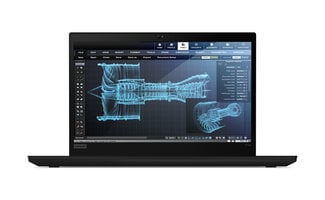

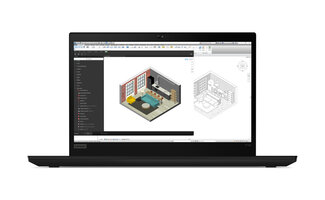
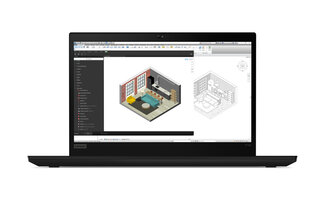

Lenovo ThinkPad P14s Gen 2
A workstation that looks like a regular ThinkPad
Picture an architect. In the morning she goes through a construction drawing with the contractor in the site office, in the afternoon she spins a 3D model around at a client's, and in the evening she works out another variant at home. You don't carry a three kilo workstation around for that, because sooner or later it simply stays at the office. A regular office laptop, on the other hand, is not made for that kind of work, and you notice as soon as a drawing gets bigger. That is exactly the situation Lenovo built the Lenovo ThinkPad P14s Gen 2 for: a laptop you carry like a normal business laptop, but built inside for heavier work.
You can't tell from the outside. The P14s Gen 2 has the same chassis as the ThinkPad T14 Gen 2: 329 by 227 millimetres, the familiar keyboard with the red TrackPoint, and the same ports in the same places. The difference is in the components and in how Lenovo tests it. That makes it a true workstation laptop, a category Lenovo keeps separate from its regular business models. A mobile workstation, in the size of a regular laptop, and that sentence sums up what the whole P14s line is about.
In this story you'll read what that means in practice. How does it differ from the T14, why are there two versions, and how do you choose between them? We also go through the screen, memory, ports and build, each time asking what it does for you. That way you can confidently buy a refurbished laptop that suits the work you do. With a refurbished ThinkPad P14s Gen 2 you get a full workstation without paying the price of a new one.
What makes a P14s different from a T14?
If two laptops share the same chassis, where is the difference? It's a fair question, because side by side the P14s Gen 2 and the Lenovo ThinkPad T14 Gen 2 are almost impossible to tell apart. The difference is in three places, and all three are in Lenovo's official specifications. Together they decide whether you have a laptop that can handle the work, or a laptop that was made for it.
A graphics card for work
The Intel version of the P14s Gen 2 has an NVIDIA T500 with 4 GB of GDDR6 memory. That card comes from the same professional range as the former Quadro cards. The Intel T14 Gen 2 has at most a GeForce MX450 with 2 GB, a consumer card. The difference is not just the memory. For its professional cards NVIDIA provides drivers that are tested together with the makers of design software, so your application does what you expect and doesn't act up halfway through a drawing.
Tested with the software you use
ISV stands for independent software vendor: the companies that make professional software. Lenovo has the P14s tested and certified with their applications. That means the combination of this laptop, this graphics card and that application has been checked before you start working with it. The P14s specifications have a dedicated section for this; the T14 specifications don't mention it at all. Lenovo publishes exactly which applications and versions are listed on its ISV overview for workstations. If you work with a specific package, have a quick look there and you'll know for sure.
Made for different work
The T14 is an all-round business laptop for Office, email and meetings, and it is very good at that. The P14s is made for drawing, calculating and designing. If you mainly work in the browser, in Teams and in normal-sized spreadsheets, a T14 is enough and you don't pay for what you don't use. If you work with CAD, 3D models or large datasets, the P14s is the logical choice. Still not sure? Try our buying guide, or ask us for advice.
Gen 2i or Gen 2a: two laptops under one name
Anyone searching for the P14s Gen 2 quickly comes across two names: Gen 2i and Gen 2a. They are not official names; Lenovo itself calls them the P14s Gen 2 (Intel) and the P14s Gen 2 (AMD). Everyone uses the short names, and so do we in our product titles. Lenovo P14s and ThinkPad P14s are also used interchangeably; it's the same model. More important than the name is what's inside, because the two versions are built for different work, and it pays to know the difference before you choose.
P14s Gen 2i: Intel Core with NVIDIA T500
The Intel version has an Intel Core i5-1135G7, i5-1145G7, i7-1165G7 or i7-1185G7, all 11th generation. These are efficient processors made for slim business laptops, with enough power for heavy office work and light design tasks. To compare them with other models, have a look at our Intel Core i5 laptops and Intel Core i7 laptops. There you'll also see the same processors in other ThinkPads.
The real reason to choose the Gen 2i is the NVIDIA T500. A processor can produce graphics itself, but then it has to share its power between your application and the image. A dedicated graphics card takes over that work, with its own memory. You notice it in software that uses the graphics card: rotating and zooming in a 3D model, scrolling through a large drawing, applying filters in photo editing. Looking for another laptop with a graphics card? Browse our full range.
The Gen 2i also has two Thunderbolt 4 ports (USB4, 40 Gbps). In practice that means one cable to a dock gives you power, extra monitors, network and fast storage at once. Do note one detail. Lenovo shipped the Intel version with or without an Ethernet port (RJ-45), depending on the model. Without one, you use an adapter or a dock, which is no problem for most people, but it's good to know in advance. So check the specifications of the unit you choose.
P14s Gen 2a: AMD Ryzen 5 PRO or Ryzen 7 PRO
The ThinkPad P14s Gen 2 AMD has an AMD Ryzen 5 PRO 5650U with 6 cores or a Ryzen 7 PRO 5850U with 8 cores, both with two threads per core. Think of cores as workstations inside the processor: the more there are, the more tasks can run at the same time without waiting for each other. You notice it in programming, virtual machines, data analysis and large spreadsheets, exactly the work where an office laptop starts to struggle. The Gen 2a has no dedicated graphics card; the image comes from the AMD Radeon Graphics in the processor. Also compare our AMD Ryzen 5 laptops and AMD Ryzen 7 laptops.
The AMD version has no Thunderbolt. It does have two USB-C ports with video (DisplayPort) and charging, and always a built-in Ethernet port, so you never need an adapter here. In short: choose the Gen 2i if your software uses the graphics card, such as CAD and 3D. Choose the Gen 2a if you mainly need many cores and raw computing power, such as for development and data work.
The screen: from office panel to 4K for colour work
The P14s Gen 2 has a 14 inch screen with a 16:9 aspect ratio. Most units have a Full HD panel (1920 × 1080), but even within that Lenovo offered real differences. There are panels with 300 and with 400 nits; the latter is pleasant in a bright room or next to a window. There is a touchscreen, handy when you point things out in a drawing at a client's. And there is ThinkPad Privacy Guard: a filter in the screen that makes the image unreadable for anyone looking from the side, switched on and off with a single key. That is a real help on the train or at a shared desk.
At the top sits a UHD screen (3840 × 2160) with 500 nits, 100% DCI-P3, Dolby Vision and factory colour calibration. DCI-P3 is a wide colour range from the film industry, and calibration means the colours are already adjusted when the laptop leaves the factory, so red really is red. For photographers and designers who work with colour that makes a big difference, because what you see on screen matches more closely what will later be printed or published. Looking for such a screen? See our 4K laptops or touchscreen laptops.
Memory: expandable to 48 GB
Memory is your laptop's desk: the bigger it is, the more you can have open at once without everything slowing down. In both versions of the P14s Gen 2 part of the memory is soldered to the mainboard, and there is one free memory slot. That takes it to a maximum of 48 GB DDR4-3200: 16 GB soldered plus a 32 GB module. That is plenty for heavy projects, virtual machines and many applications at once, and it means your laptop can grow with your work.
When choosing, do check how much memory is soldered, because that decides how far you can upgrade later. A unit with 16 GB soldered can go to 48 GB; with less soldered, the maximum is lower. If you start with a smaller amount, upgrading later with one module is simple. Storage differs per unit and is listed with each product.
Ports: one cable to your desk
On the P14s Gen 2 you'll find USB-A for your mouse or USB stick, USB-C, HDMI 2.0 for a monitor or projector, a microSD card reader for the cards from a camera, and a combined audio jack for your headset. That's exactly what you need on the go, without a bag full of adapters. The AMD version also has a side docking connector as standard; on the Intel version it was optional.
It works best with a dock. At the office or at home you plug in one cable and immediately have your monitors, keyboard, network and power. When you pick up the laptop, you simply take your work with you, without closing anything or setting things up again. On the Intel version Thunderbolt is the fastest route, but a USB-C dock works on both versions. Have a look at our Lenovo docking stations.
Online anywhere with 4G
If you often work on the go, 4G is a relief: no fiddling with a hotspot on your phone or with public Wi-Fi you'd rather not trust. Lenovo shipped the P14s Gen 2 in three ways: with a factory 4G module, without a module but with the antennas already built in, or without 4G at all. Only a unit with both module and antennas is a true laptop with a SIM card slot; an empty slot is not enough. So check the specifications for 4G. Looking for a laptop with SIM card that can go online straight away? Have a look at that overview.
Built for a life in a bag
The P14s Gen 2 is tested to MIL-STD-810H, an American military standard in which devices are tested for things like shock, vibration and temperature. That doesn't make it indestructible, but it is built for a life in bags, trains and site offices. It's also one of the reasons ThinkPads are used so widely in companies: they are made to last for years, which makes them ideally suited to a second life as a refurbished laptop.
It weighs from about 1.46 kg (AMD) or 1.47 kg (Intel). Lenovo also offered the Intel version with an aluminium lid and in storm grey, next to the classic black. The battery has a capacity of 50 Wh, and with us it always has more than 80% of its original capacity. So you get the weight and sturdiness of a regular business laptop, with the inside of a workstation.
Linux or Windows 11: at home in both
Many developers work with Linux, and the P14s Gen 2 is a good choice for that. Lenovo also shipped the Intel version with Ubuntu, and the AMD version with Ubuntu or Fedora. So Lenovo itself tested the hardware on Linux, which saves you hunting for drivers for Wi-Fi, sound and power management. See our Linux laptops.
Prefer Windows? You're covered too. Both processors are officially supported by Windows 11, so you simply receive Microsoft's security updates and new features. For most design software, Windows is also the platform it is made and certified for. See our Windows 11 laptops.
ThinkPad P14s Gen 2 specifications
| Component | P14s Gen 2i (Intel) | P14s Gen 2a (AMD) |
|---|---|---|
| Processor | Intel Core i5-1135G7, i5-1145G7, i7-1165G7, i7-1185G7 (11th gen) | AMD Ryzen 5 PRO 5650U (6 cores), Ryzen 7 PRO 5850U (8 cores) |
| Graphics | Intel Iris Xe, or NVIDIA T500 4 GB GDDR6 | AMD Radeon Graphics (integrated) |
| Memory | DDR4-3200, up to 48 GB (partly soldered, 1 slot) | DDR4-3200, up to 48 GB (16 GB soldered, 1 slot) |
| Screen | 14 inch, 16:9, Full HD (300 or 400 nits, touch, Privacy Guard) or UHD 3840 × 2160 with 100% DCI-P3 | |
| Ports | 2× Thunderbolt 4 / USB4, 2× USB-A, HDMI 2.0, microSD, audio, RJ-45 depending on model | 2× USB-C (video and charging), 2× USB-A, HDMI 2.0, microSD, audio, RJ-45 |
| 4G | Per model: factory module, antenna ready, or none | |
| Weight | from 1.47 kg | from 1.46 kg |
| Battery | 50 Wh | |
| Durability | MIL-STD-810H | |
| Linux preload | Ubuntu | Ubuntu, Fedora |
Source: Lenovo PSREF, specifications P14s Gen 2 (Intel) and P14s Gen 2 (AMD). The exact configuration of your unit is listed with the product.
How the Gen 2 fits into the family
The P14s Gen 2 doesn't stand alone. It has a predecessor, a successor, a business twin and a big brother. This is how it relates to that family, so you can see whether another generation or another model might suit you better.
- Lenovo ThinkPad P14s Gen 1: the predecessor and the entry point of the P14s line. The Intel version has a 2 GB NVIDIA Quadro P520 and Thunderbolt 3. Fine for 2D drawing and light 3D tasks, with the same chassis and the same 48 GB memory maximum.
- Lenovo ThinkPad P14s Gen 3: the successor, with a taller 16:10 screen, 12th generation Intel Core P processors and an NVIDIA T550. Note: the microSD reader and side dock were dropped, and on the AMD version the memory is fully soldered.
- Lenovo ThinkPad P14s Gen 4: the generation after that, with 13th gen Intel Core P, NVIDIA RTX A500 and an optional 2.8K OLED screen.
- Lenovo ThinkPad T14 Gen 2: the same chassis without a workstation card and without ISV certification, for mostly office work.
- Lenovo ThinkPad P15 Gen 2: the big brother with a 15.6 inch screen, for those who prefer a large screen over a light device.
Want to see all models side by side? Browse our workstation laptops or the full range of Lenovo ThinkPad laptops.
Who is the P14s Gen 2 for?
Back to the architect from the beginning. She is one of the people this laptop was made for, but certainly not the only one. What they all have in common: they do work that is heavier than email, and they don't want to carry a heavy laptop for it.
- Designers, architects and draughtsmen looking for a laptop for AutoCAD or Revit to take to clients or building sites. Choose the Gen 2i with NVIDIA T500.
- Developers and IT professionals who use virtual machines, containers or Linux. The Gen 2a with Ryzen 7 PRO and 48 GB of memory is strong here.
- Photographers and video makers who work on the go, especially with a unit that has the UHD screen. See also laptops for photo editing and laptops for video editing.
- Businesses that want a fixed desk with a dock and a laptop that also works away from the office. See our business laptops.
When not? The T500 is an entry-level card in the professional range. For heavy 3D rendering, large BIM models or gaming, a workstation with a more powerful graphics card is a better fit, such as the P15. Choosing honestly now saves you from having to switch again in a year.
Why buy a refurbished P14s Gen 2 from Qwerty-Tech
You buy a workstation to work with it for years, so you want to know what you're getting. Qwerty-Tech specialises in refurbished Lenovo ThinkPads, and with a P14s we do more than clean and install it. We always replace the CMOS battery: the coin cell that keeps the clock and BIOS settings, and that runs flat after a number of years. We apply new thermal paste between the processor and the cooler, because old paste dries out, which makes a laptop run hotter, its fan spin louder and its processor slow itself down. With a workstation you push hard, that makes a real difference. And the battery always has more than 80% of its original capacity.
Every laptop is tested by at least three people, and separately graded on its condition by at least three people. It is then updated and freshly installed, so you take it out of the box and start working straight away. You get a 2-year warranty, and we ship from our own stock, without middlemen.
Need several laptops for your business, school or organisation? Request a custom quote and we'll help you find the right configuration. And it's a sustainable choice: a laptop that is reused does not have to be made again. For a sturdy machine like the P14s, that second life is one it handles with ease.
Frequently asked questions about the ThinkPad P14s Gen 2
What is the difference between the P14s Gen 2i and Gen 2a?
The Gen 2i has an 11th generation Intel Core processor, Thunderbolt 4 and usually an NVIDIA T500 graphics card. The Gen 2a has an AMD Ryzen 5 PRO or Ryzen 7 PRO with more cores, but no dedicated graphics card and no Thunderbolt. Choose Intel for CAD and 3D, and AMD for work that needs many cores.
Is the ThinkPad P14s Gen 2 suitable for AutoCAD?
For 2D drawing and light 3D models it is, especially the Gen 2i with NVIDIA T500. Lenovo certifies the P14s for professional software; check Lenovo's ISV overview to see whether your application and version are listed. For heavy 3D models a workstation with a more powerful graphics card is better.
How much memory does the P14s Gen 2 support?
Up to 48 GB DDR4-3200. Part is soldered to the mainboard, and there is one slot for a module of up to 32 GB. How much is soldered determines the maximum.
Does the P14s Gen 2 have a SIM card slot?
Only the units with a 4G module and antennas. Lenovo also shipped models without 4G. The specifications of each unit show whether 4G is present.
What is the difference between the P14s Gen 2 and the T14 Gen 2?
They share the chassis. The Intel P14s has a professional NVIDIA T500 instead of a GeForce MX450, and Lenovo certifies it for professional software (ISV). The T14 is meant for general business use.
How heavy is the ThinkPad P14s Gen 2?
From about 1.46 kg for the AMD version and 1.47 kg for the Intel version, depending on screen and lid.
Does the P14s Gen 2 work with a docking station?
Yes. Both versions work with a USB-C dock. The Intel version reaches the highest speed with a Thunderbolt dock. Have a look at our Lenovo docking stations.
Is a refurbished P14s Gen 2 a good choice?
Yes, if you want a workstation the size of a normal laptop. You get a checked and freshly installed device with a 2-year warranty, and you pay less than for a new workstation.


